1518 Legacy Dr, 1st Floor, Ste 112, Frisco TX

(469) 701-2333

Client Portal


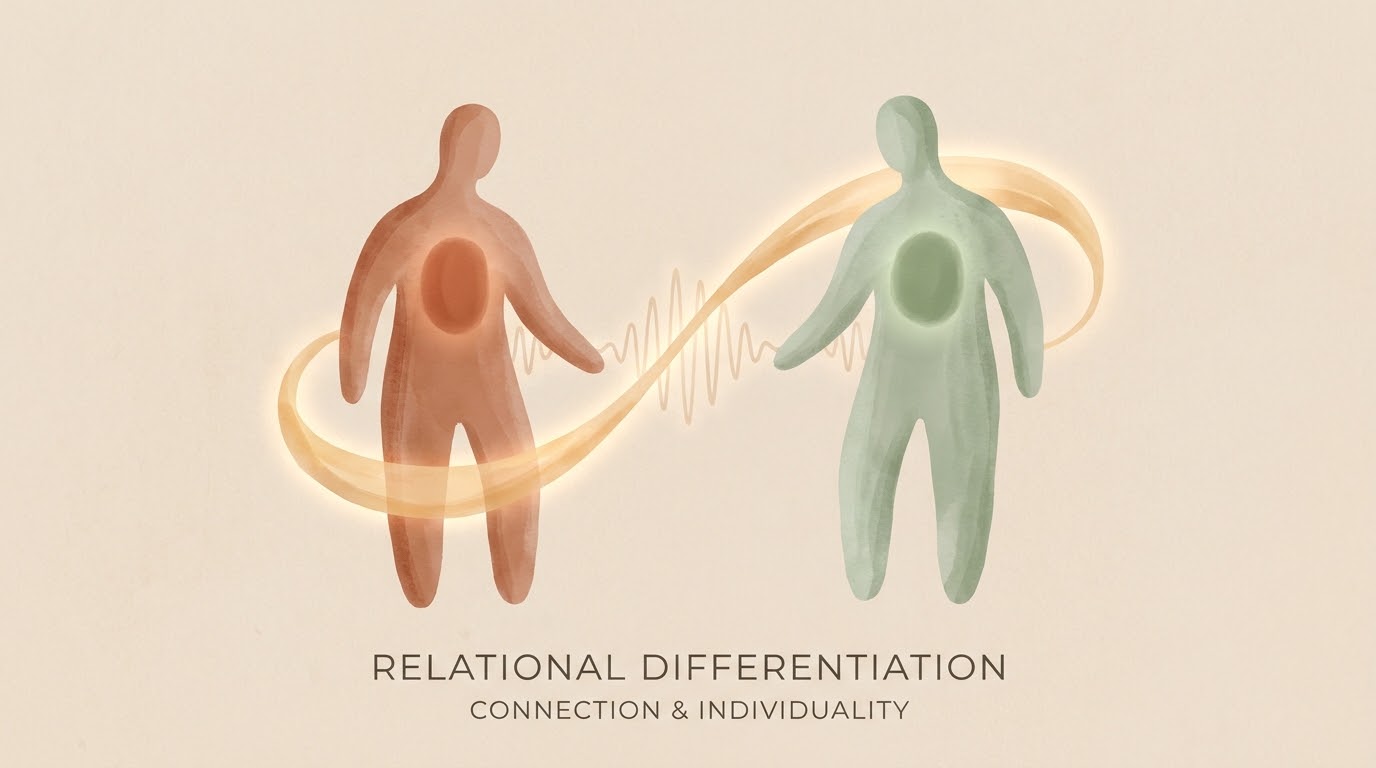

Maintain personal identity and emotional autonomy to cultivate deeper, healthier intimacy in your relationship.
In long-term relationships, partners frequently confront an unspoken, agonizing dilemma: Must I surrender who I am to keep this relationship alive, or must I pull away to preserve my own identity?
This tug-of-war between closeness and independence lies at the heart of relational distress. When intimacy feels synonymous with self-abandonment, partners naturally begin to feel anxious, overwhelmed, or resentful. Conversely, when independence turns into emotional self-defense, partners drift into isolation.
To understand how differentiation operates in real-life partnerships, it is essential to map the three primary ways individuals navigate togetherness and autonomy. Relationships fluctuate along a dynamic spectrum between two reactive extremes and one grounded middle ground.
Here’s a comparison of how these three relational states affect us:
Relational State | Structural Dynamic | Somatic & Emotional Experience | Underlying Threat Pattern
Fusion
Togetherness at the cost of Self
Partners absorb each other's anxiety, falling into comparison spirals, overfunctioning, and people-pleasing to extinguish relational tension.
Fear of abandonment or rejection; belief that differences signify disconnection or relationship failure.
Cutoff
Self at the cost of Togetherness
Characterized by defensive self-sufficiency, walling off emotions, numb disengagement, and anticipatory withdrawal.
Fear of engulfment, control, or losing one's identity; belief that closeness inevitably leads to being consumed.
Interdependence
Balanced Connection and Autonomy
Partners hold connection and difference simultaneously, speaking from authentic "I-Positions" while welcoming the partner's unique experience.
Capacity to tolerate ambiguity and difference; rooted in autonomic safety, self-leadership, and curiosity.
In fused relational dynamics, the boundary between "where I end and you begin" becomes blurred. When one partner experiences stress, sadness, or anger, the other partner's nervous system immediately absorbs that distress as an urgent threat that must be fixed or mitigated. In an attempt to restore internal calm, partners often resort to overfunctioning—taking responsibility for the other person’s emotions, guessing unstated needs, or suppressing their own preferences to avoid friction. While fusion creates a brief illusion of safety, it ultimately suffocates authentic intimacy because neither partner is truly being seen as an independent individual.
When fusion becomes suffocating, the system often rebounds into emotional cutoff. Cutoff occurs when an individual decides that the only way to preserve their autonomy is to physically, emotionally, or sexually pull away. In cutoff, self-sufficiency becomes a fortress. Partners may adopt an attitude of "I don't need anyone," engaging in anticipatory withdrawal before conflict even begins. While cutoff protects the self from being consumed, it starves the relationship of genuine warmth and shared vulnerability.
Interdependence represents the mature integration of intimacy and autonomy. Rather than viewing differences in desire, opinion, or emotional state as evidence of relational breakdown, differentiated partners recognize that differences are expected biological and relational rhythms. Interdependence allows partners to say, "I care deeply about your experience, and I also honor my own."
Why is holding onto oneself so difficult when emotional stakes are high? When relational tension arises, the nervous system often misinterprets emotional difference as a physical safety threat.
Polyvagal-Informed clinical theory explains that when a partner expresses a conflicting desire or emotional distance, our autonomic nervous system can instantly shift out of a grounded Ventral Vagal state (safe and connected) and plunge into Sympathetic activation (fight or flight) or Dorsal Vagal shutdown (numbness and collapse).
In Internal Family Systems (IFS) terms, this autonomic shift triggers younger, protective parts of our personality to "grab the steering wheel" of the nervous system:
The Parts-Informed Metaphor for ReactivityWhen the nervous system detects a relational threat, an activated, younger defensive part often grabs the wheel—reacting with rigid either/or demands, intense anxiety, or stone-faced withdrawal. The clinical goal is not to shame or banish these protective parts, but to ground the body and return the integrated Adult Self (Wise Mind) to the driver's seat to widen the window of tolerance.
When the Adult Self is at the wheel, partners can pause, regulate their autonomic arousal, and operate from what Dialectical Behavior Therapy (DBT) terms Wise Mind—the synthesis of emotional feeling and logical reason.
Differentiation is not an abstract philosophical concept; it is an active daily practice executed through specific linguistic, somatic, and behavioral choices.
To shift out of reactive conflict cycles, partners utilize the Horizontal to Vertical Framework, moving from reactive back-and-forth blaming to internal tracking and grounded communication:
An "I-Position" is a statement that clearly articulates what I think, feel, need, or will do, without defining, criticizing, or demanding change from the partner:
Speaking from an I-Position takes full ownership of one's emotional state, freeing the partner from having to defend themselves against accusations.
Holding onto the self while staying connected to a partner requires regular physical practice that signals safety to the autonomic nervous system. Specific somatic exercises and micro-connection rituals provide structured, low-pressure containers for connection that preserve individual autonomy.
Before partners can hold a differentiated boundary, their bodies must reach a state of physiological stability. Two core somatic exercises support this transition:
Rather than letting emotional ebbs or desire discrepancies accumulate into silent resentment, partners can establish a 15-Minute Weekly Container to review relational shifts:
Re-Framing Intimacy: Presence Over Performance
Ultimately, holding onto the self while connecting to the "we" requires shifting the ultimate goal of long-term partnership from performance to presence.
As highlighted in differentiation-based intimacy literature—such as David Schnarch’s Passionate Marriage, Esther Perel’s Mating in Captivity, Betty Martin’s The Art of Receiving and Giving, and Roberta Gilbert’s Extraordinary Relationships—true sexual and emotional intimacy does not require total sameness, endless agreement, or continuous sexual continuation.
Pauses in desire and fluctuations in closeness are expected biological rhythms. When partners learn to remain grounded in their own bodies, speak from authentic I-Positions, and respect where they end and their partner begins, relationship ebbs cease to feel like existential threats. The outcome is a resilient, evolving partnership built on mutual respect, deep self-leadership, and lasting connection.
Credits & References
Much Respect,
Melinda Porter (content) and AI (organization, grammar, order, and the reason blogs get done by me)