1518 Legacy Dr, 1st Floor, Ste 112, Frisco TX

(469) 701-2333

Client Portal



'Healthy differentiation' is the ability to remain a whole, autonomous person while staying meaningfully connected to others. It is not emotional distance or hyper-independence.
Many people come into therapy convinced of one painful belief:
Feeling that their ablity to pick healthy people is broken.
They say it after a string of relationships that didn’t work, after realizing they lost themselves again, or after noticing how easily they fuse, fix, or disappear in connection. It’s often said half-jokingly—but it carries a deep sense of shame.
I don’t believe people are broken.
And I don’t believe their picker is broken either.
What I see instead is something far more workable: an underdeveloped skill shaped by repetition, survival, and inaccurate interpretation. Skills can be developed. Broken things feel like they should be discarded. People are not disposable.
That distinction matters.
Differentiation is often misunderstood as emotional distance, hyper-independence, or “not needing anyone.” In reality, healthy differentiation is the ability to remain a whole, autonomous person while staying meaningfully connected to others.
Think of two people standing side by side rather than leaning on one another to stay upright. Neither person is responsible for holding the other up, yet they’re still together. The connection is chosen—not required for survival.
That’s differentiation without disconnection.
One way I help clients understand differentiation is through a simple four-point compass. When all four directions are present, people tend to feel grounded, clear, and connected. When one is missing, they drift, often back into familiar but painful patterns.
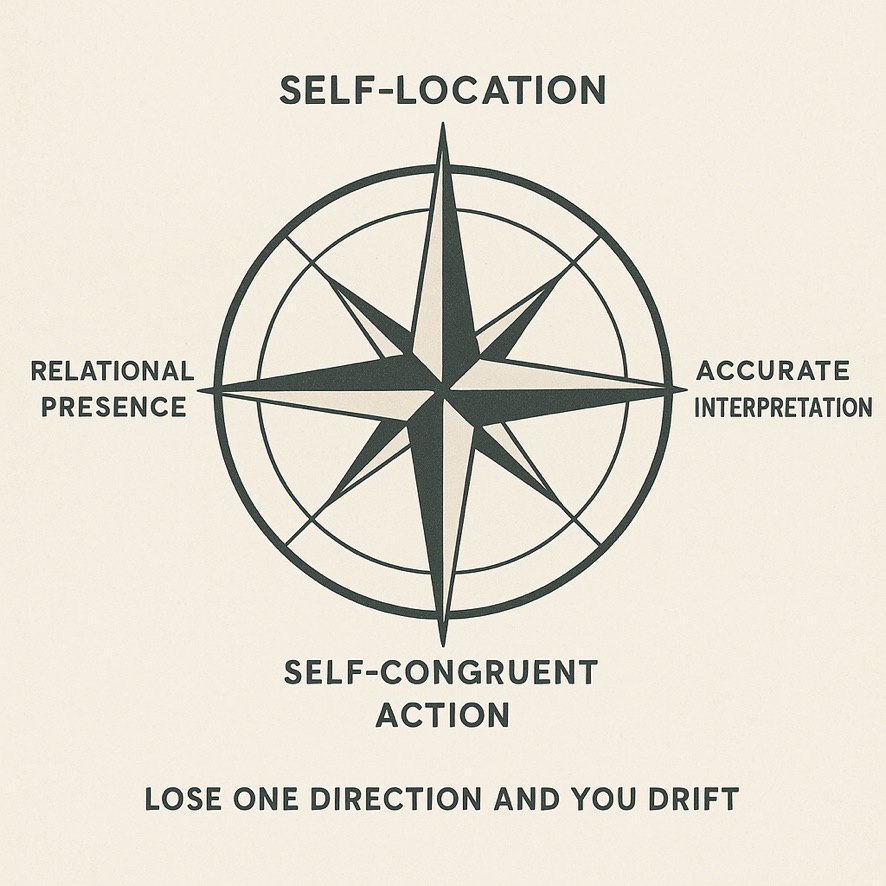
Can I find myself while I’m with you?
Self-location is the ability to notice what’s happening internally when another person is present; thoughts, emotions, body cues, impulses to please or withdraw. Many people know who they are alone, but lose access to themselves in relationship.
If you can’t locate yourself, you can’t make grounded relational choices. You can only react.
Am I seeing what’s happening or what I hope is happening?
This is where the “picker” gets developed. Inaccurate interpretation often comes from trauma, attachment patterns, or longing. We fill in gaps with stories, intentions, and potential; sometimes, at the expense of reality.
Accurate interpretation means responding to observable behavior rather than imagined futures. Differentiation requires reality. Hope without accuracy leads to fusion.
Can I behave in ways that align with who I am when it’s uncomfortable?
This is where differentiation becomes visible. Self-congruent action includes setting boundaries, expressing needs, and making choices that align with values rather than fear of losing connection.
People often confuse kindness with self abandonment. But consistently betraying yourself to preserve connection isn’t kindness; t’s a slow erosion of integrity.
Can I stay emotionally present without merging or disappearing?
Differentiation fails if autonomy requires emotional cutoff or if connection requires the self to became smaller. Relational presence is the ability to remain open, compassionate, and engaged without taking responsibility for another person’s emotional regulation.
This is where co-regulation happens naturally, not transactionally.
When one of these capacities is missing, people tend to fall into familiar roles: the caretaker, the pleaser, the avoider, the fixer. They may feel connected but not whole. Or autonomous but lonely.
Differentiation isn’t about perfection. It’s about orientation.
I often use dating as a real world practice ground for differentiation. Many clients want to date but don’t know how to stay themselves while doing it. So I ask them to focus on first dates only.
First dates remove many of the accelerants that blur discernment excessive texting, obligation, sexual momentum, and emotional investment. Instead of asking, “Do I like this person?”
I ask something that usually stops people in their tracks:
“Did you like yourself in that environment?”
Did you feel like you had to perform?
Minimize?
Leave parts of yourself out?
Say yes when you meant no?
That question shifts the focus from outcome to self-experience. It helps people choose environments and relationships that support who they are becoming.
Differentiation isn’t a character trait you either have or don’t have. It’s a set of skills that develop over time, often later in life, and often with practice and support.
If your patterns feel familiar, repetitive, or frustrating, it doesn’t mean you’re broken. It means something learned long ago may be ready for reconstruction.
You don’t have to disconnect to protect yourself.
And you don’t have to lose yourself to stay connected.
Differentiation allows you to stand whole in relationship.
Much Respect,
Melinda Porter

What is one small boundary or choice (Self-Congruent Action) you could implement in that situation that would align with your values, even if it feels uncomfortable in the short term?